
Analysis helps us determine who to target—with which types of programming—based on the risks they face.
To access CARE's Do No Harm in Practice Toolkit, please use your username and password to log in below.
Don't have an account yet? Register now. Forgot your password? Click here.
Already have an account? Head over to the login page.
Content on this page is managed in the User Profile - DNHP Toolkit template.
By the very end stages of program implementation, it’s no longer possible to undertake baseline or midline surveys to set a reference against which you can directly measure changes in women, girls and other vulnerable groups’ perceptions of safety resulting from your intervention. However, even at this stage, all program teams should still develop an M&E (or just evaluation) plan that investigates whether or not/the degree to which program participants felt safe in accessing/using the program, good or service.
There are two points here that are critical to remember regardless of where you are in your existing programming cycle (i.e., beginning, middle or end):
While it’s true that some programmatic interventions to mitigate the risk of VAWG can require funding and/or take time to implement, this is not universally the case.
Course corrections like adding additional WASH facilities to allow for greater privacy or sex segregation, installing lighting, adding locks, sturdier doors or additional privacy measures for shelters would all require funds that - if not budgeted for in the original proposal - might be difficult to find midway through or toward the end of a program.
However, there are plenty of risk mitigation interventions that can be implemented at very little cost, or even no cost at all – and not being able to do everything should not be a reason to not do anything.
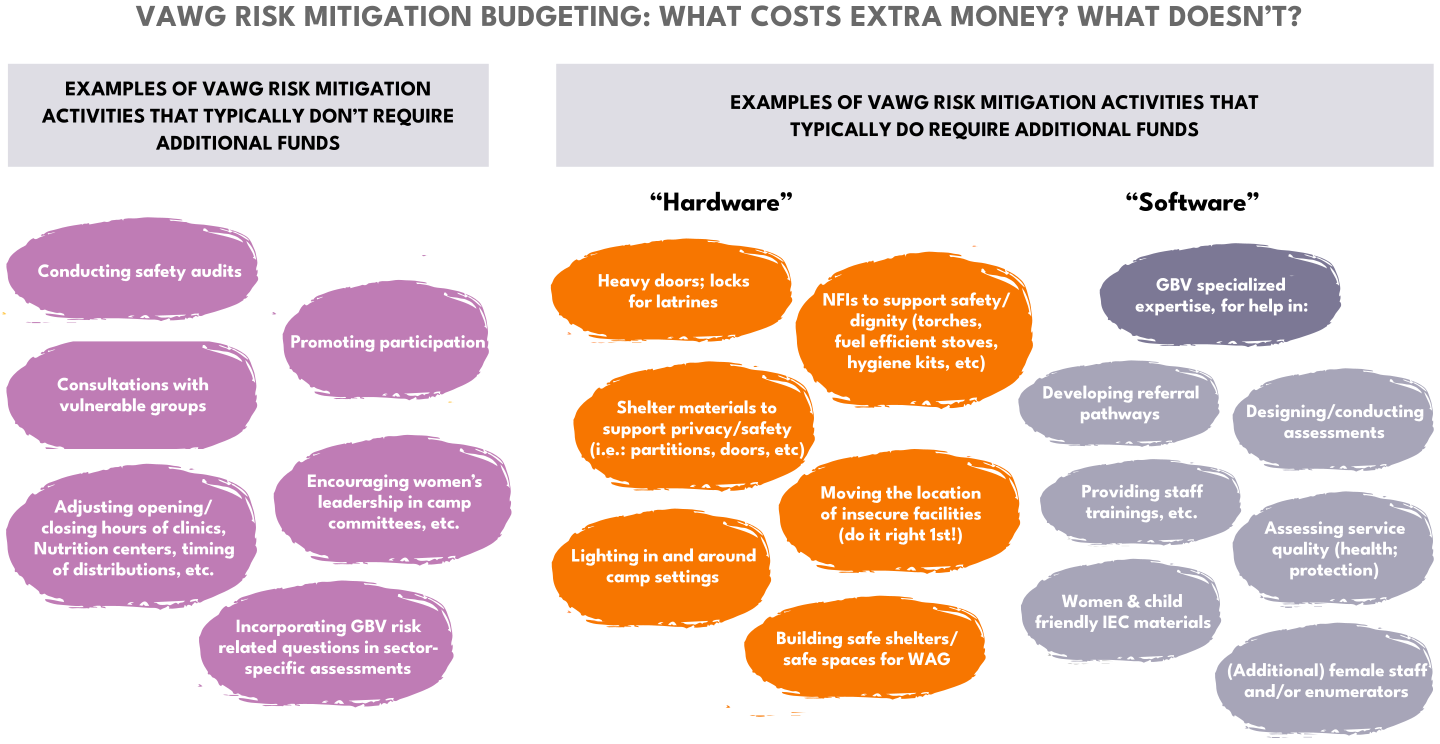
Many accessibility barriers can be addressed without significant additional cost or time, for example:
Hosting trainings to build capacity of staff to conduct safe and ethical consultations with women, girls and other vulnerable groups and/or to respond safely to disclosures may be able to be built into existing trainings, or training budgets can be repurposed.
Adding one or two indicators to assess accessibility and/or safety perceptions into existing assessments or routine monitoring should not require additional funding or time.
Analysis helps us determine who to target—with which types of programming—based on the risks they face.
Analyzing the data and information collected during assessments is critical for identifying and understanding risks related to VAWG and/or barriers to access, and which population(s) are most affected.
Analysis forms the cornerstone of proposals and project design. The results of analysis should be used to determine what actions, activities, and/or strategies need to be put in place to address each of the risks identified during assessments and to improve sector-specific outcomes.
Analysis starts with the same basic questions that should be asked while reviewing the data and information gathered from various forms of assessment.
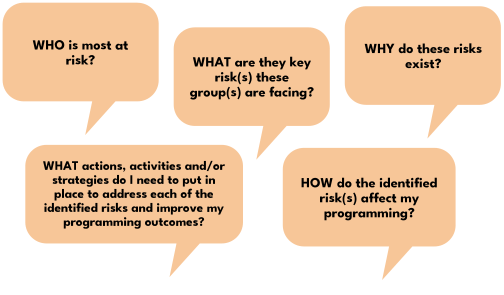
To help organize the information in your analysis, you can use this basic, fillable GBV risk analysis form:
The common thread of analysis throughout the program cycle can help keep the risks and needs of specific vulnerable populations identified during the assessment phase front and center in proposal writing and program design and implementation.
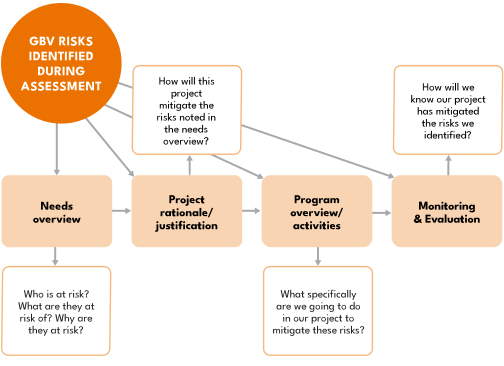
Designing interventions to mitigate risks of VAWG and reduce the barriers to access faced by women, girls and other vulnerable groups is just good programming. Ensuring that our programs are safe and accessible to all, including and especially the most vulnerable or marginalized within a community, is not “additional” work—rather, ensuring that actions to mitigate the risk of VAWG are integrated into every sector’s programs should result not only in safer programming overall, but also in better sector-specific outcomes.
Understanding the risks that different groups within an affected population may be facing allows for the design of programming to better and more safely meet their needs.
There is no one size fits all approach to designing programming that mitigates risks of VAWG. Rather, successful implementation activities need to be determined by the context. Strategies to mitigate risks of VAWG provide a framework to identify where risk mitigation actions should be implemented based on context.
ALL sectors must work to mitigate the risks associated with their programs to ensure that women, girls, and other vulnerable groups can safely access and use them.
There are multiple entry points for understanding where and how GBV risk mitigation strategies/actions can be implemented in humanitarian action.
GBV risks can occur across all levels of intervention [societal/institutional, community, and individual/service delivery] and therefore there are opportunities at each of these levels to engage in GBV risk mitigation.
Please click on the boxes to see example strategies that can be incorporated.
The diagram below indicates areas where GBV risks are commonly found and the general types of interventions that can help mitigate those risks. To ensure that interventions are as effective as possible in the context in which they are to be implemented, it is critical to include GBV risk related questions in every sector’s assessments.
Click on a circle to view a corresponding programmatic intervention.
For additional guidance on general good practice for VAWG risk mitigation interventions, save this tipsheet.
Based on your analysis, you may need to make course corrections to ensure your programming is as safe and accessible as possible. The “How-to Guide” below provides a helpful roadmap for course corrections.
For guidance on common sector specific VAWG risk mitigation interventions, please click on your sector tool below.
Additional information can be found in the Thematic Area Guides (TAGs) of the GBV Guidelines, linked from the icons below.


You can conduct a midline survey in two situations:
If you conducted a baseline survey at the start of your project, the midline survey should include, at minimum, the same questions asked in the original baseline. You can also add new questions if you need to account for changes in the context or other factors.
Conducting a midline survey in this scenario helps you:
If you didn’t conduct a baseline survey, a midline survey helps you:
You do not need to conduct a standalone/separate midline survey just for VAWG risk mitigation, unless that makes sense for your specific context/situation. Instead, you can weave safety and access questions into any midline assessment that you’re planning to conduct for your project. This approach mirrors how you could incorporate questions about access barriers and safety perceptions into your regular sector-specific assessments.
The sample midline survey provided includes various questions you can pick, choose and adapt , as best suits your project and context.
NOTE: the midline survey included here is exactly the same as the baseline survey from this toolkit.
As in any instance when you’re asking questions about safety, please ensure you (and all enumerators, etc.) have read and understood the tipsheet on asking safety-related questions (linked in the baseline survey document itself).
When you begin your programming, asking questions about safety and barriers to access will help to establish a baseline starting point. You can then measure whether your VAWG risk mitigation strategies are actually working by comparing future results against the baseline.
There is no need to conduct a standalone baseline survey on VAWG risk mitigation, unless that makes sense for your specific situation. Instead, you can weave safety and access questions into the baseline assessment that you’re already planning to conduct for your project. This approach mirrors how you can incorporate questions about access barriers and safety perceptions into your regular sector-specific assessments.
The sample baseline provided includes various questions that you can pick, choose and adapt to best fit your project and context.
As in any instance when you’re asking questions about safety, please ensure you (and all enumerators, etc.) have read and understood the tipsheet on asking safety-related questions (linked in the baseline survey document itself).
This site is always being updated, so please check back often for new additions, tools, and resources!
Copyright © 2026 • GBV Guidelines